
Online slots for Beginners: A Complete Guide
This guide is for anyone who wants to stop guessing. We will cover how slots actually work, what the numbers on the screen mean, how to read a paytable, and how to choose a game that matches your budget instead of your mood.
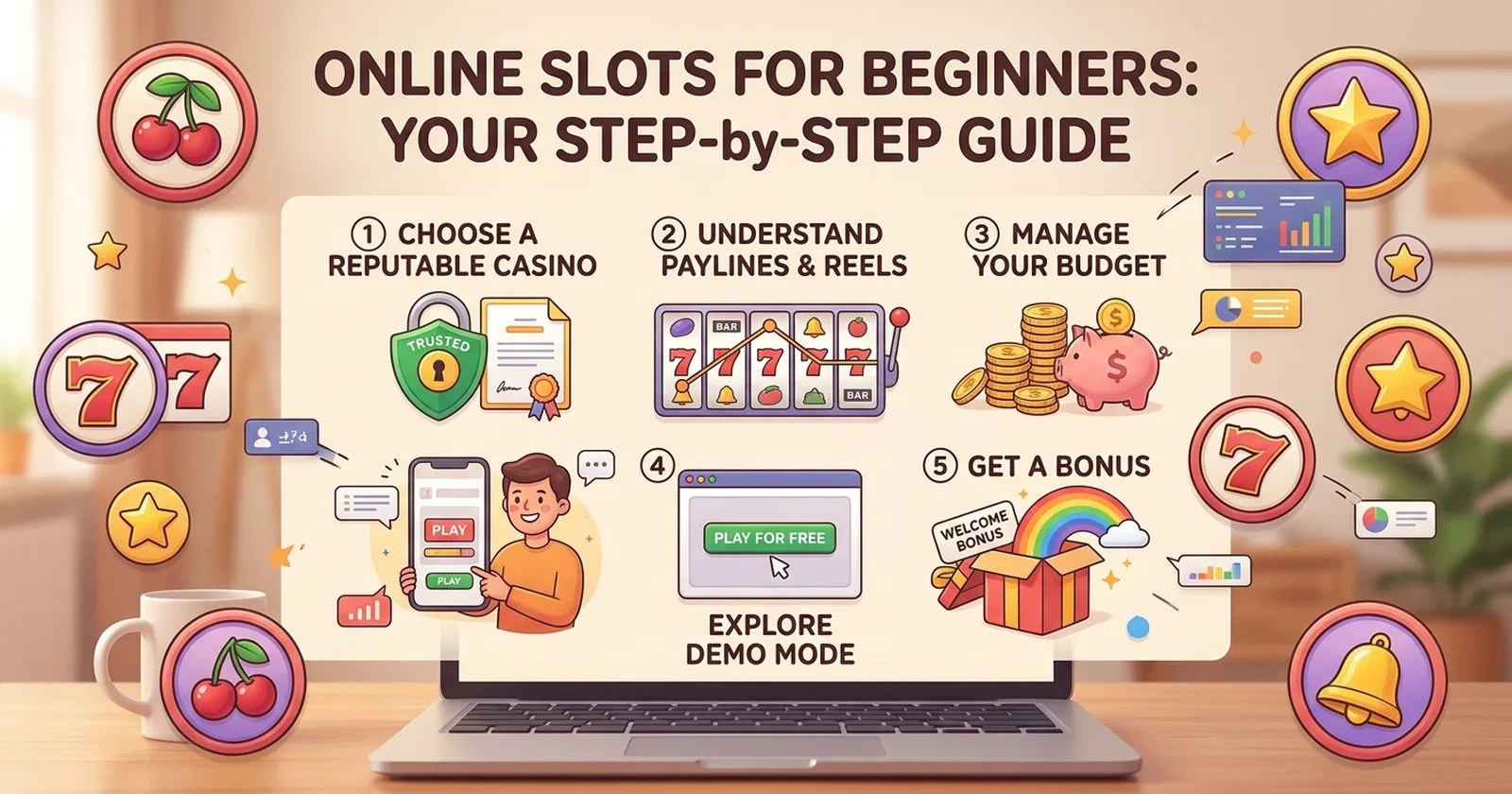
This guide is for anyone who wants to stop guessing. We will cover how slots actually work, what the numbers on the screen mean, how to read a paytable, and how to choose a game that matches your budget instead of your mood.
Online Slots for Beginners: What You Actually Need to Know
A slot machine is a random number generator wrapped in graphics. Every spin is independent. The result of your last spin has zero influence on your next one. That single fact explains most of what confuses new players.
The house edge on most online slots sits between 2 and 8 percent, depending on the game. That means for every 100 units you wager over a long session, you can expect to lose somewhere in that range. This is not a prediction for one session. It is a mathematical average that only becomes visible over thousands of spins.
How a Slot Game Is Built
Every slot has three core components that determine how it plays. Understanding them changes the way you pick games.
Reels and paylines. A 5x3 slot has five reels and three rows, giving fifteen visible symbols. Paylines are the patterns that must line up for you to win. Older slots had fixed paylines. Modern ones often have 243, 1024, or "megaways" systems where the number of ways to win changes with every spin.
Symbols and paytable. The paytable tells you what each symbol pays and which combinations trigger bonuses. Low-value symbols are usually card ranks like 10, J, Q, K, A. High-value symbols are themed icons. Wilds substitute for other symbols. Scatters trigger free spins or bonus rounds, and they usually pay regardless of position.
Return to Player (RTP). This is the percentage of all wagered money a slot is designed to pay back over millions of spins. An RTP of 96 percent means the game keeps 4 percent on average. RTP is not a guarantee for your session. It is a long-term figure.
Reading a Paytable Before You Spin
Most beginners skip the paytable. That is a mistake. The paytable tells you more about a game than any review will.
Open the paytable and look for three things. First, the maximum win. Some slots cap at 5,000x your stake, others at 50,000x. Second, the bonus trigger. Is it three scatters, four, or a random event? Third, the wild behavior. Does the wild expand, multiply, or stay fixed?
If the paytable takes more than a minute to understand, the game may be more complex than you want for a casual session. That is not a flaw. It just means the game is built for a different type of player.
Slot Volatility and What It Means for Your Budget
Volatility describes how a slot distributes its wins. It has nothing to do with RTP, and confusing the two is common.
| Volatility | Win Frequency | Win Size | Best For |
|---|---|---|---|
| Low | Frequent | Small | Long sessions on a small budget |
| Medium | Moderate | Moderate | Balanced play |
| High | Rare | Large | Players chasing big wins who can absorb dry spells |
If you have 50 units to spend and want the session to last, low volatility is your friend. If you are willing to lose most of it for a shot at a large payout, high volatility is the trade. Neither is better. They just suit different plans.
Choosing a Game That Fits You
Start with your session budget, not the game. Decide how much you are willing to lose before you open the site. Then pick a slot whose minimum bet lets you place at least 100 spins within that budget.
If your budget is 50 units, a slot with a 0.10 minimum gives you 500 spins. A slot with a 1.00 minimum gives you 50. The first game gives you room to ride out a cold streak. The second does not.
Beyond budget, look at theme and features. A game you find boring will make you spin faster, and spinning faster burns budget faster. Pick something you actually enjoy watching, because you will be watching it for a while.
Common Beginner Mistakes
Chasing losses is the big one. The urge to increase your bet after a dry spell feels logical, but it is not. Each spin is independent. Increasing your stake does not improve your odds, it only increases how fast your budget disappears.
Another mistake is playing games with unclear bonus terms. If a slot awards free spins, check whether the winnings from those spins carry a wagering requirement. Many do, and the requirement can be steep.
Finally, some players believe a machine is "due" for a win. It is not. Random number generators have no memory. A slot that has not paid in an hour is no more likely to pay in the next minute than it was at the start.
Where to Play
If you are looking for a platform to try these games, ankertoto is one option worth checking. Look for a site that lists RTP clearly, publishes its licensing information, and offers a demo mode so you can test a game before spending real money.
Demo mode is underused. It lets you learn a slot's rhythm and bonus mechanics without risking anything. Spend fifteen minutes in demo before you play for real, and you will make fewer mistakes.
Final Thoughts
Online slots are entertainment, not an income strategy. The math guarantees the house wins over time. What you control is how long your money lasts and whether you enjoy the session.
Understand RTP, respect volatility, set a budget before you start, and pick games you actually like. Do those four things and you will get more out of every session than most players ever do.
Frequently Asked Questions
Are online slots rigged?
Licensed slots use certified random number generators that are audited by third parties. The outcome is random, not rigged. The house edge is built into the paytable, not into a hidden mechanism. If a site is unlicensed, that is a different matter, and you should avoid it.
What RTP should I look for?
Anything above 96 percent is considered good for a slot. Some games reach 97 or 98 percent. Below 95 percent is on the low side, though it does not make a game unplayable, it just means the house edge is larger.
Can I win consistently on slots?
No. No strategy changes the underlying math of a random number generator. You can manage your budget and extend your playtime, but you cannot shift the odds in your favor over the long run.
Is it better to play free slots or real money slots?
Free or demo slots use the same random number generator as real money versions. They are ideal for learning a game. Real money adds stakes and pressure, which changes how people play, often for the worse.
How much should I budget for a slot session?
Only what you are comfortable losing entirely. A common approach is to set a monthly entertainment budget and divide it across sessions. Never use money set aside for bills, savings, or anything essential.
More in Online Games
 Online Games
Find Online Game Communities That Share a Rider Mindset
Finding people who think the way you do is harder than it sounds, whether the context is a riding group or an online game...
 Online Games
Discover How Online Game Worlds Mirror Motorcycle Racing
Riding a real motorcycle and racing one inside an online game draw on surprisingly similar instincts, even though only one of...
 Online Games
Tips for Managing Your Bankroll in Online Games
Bankroll management, deciding how much you are willing to spend and sticking to it, is one of the most important habits in...