
Understanding RTP and Volatility in Games
Two slot games can look identical and behave completely differently. One pays small amounts every few spins. The other stays quiet for twenty minutes and then drops a win that covers your entire session. The difference is not luck.
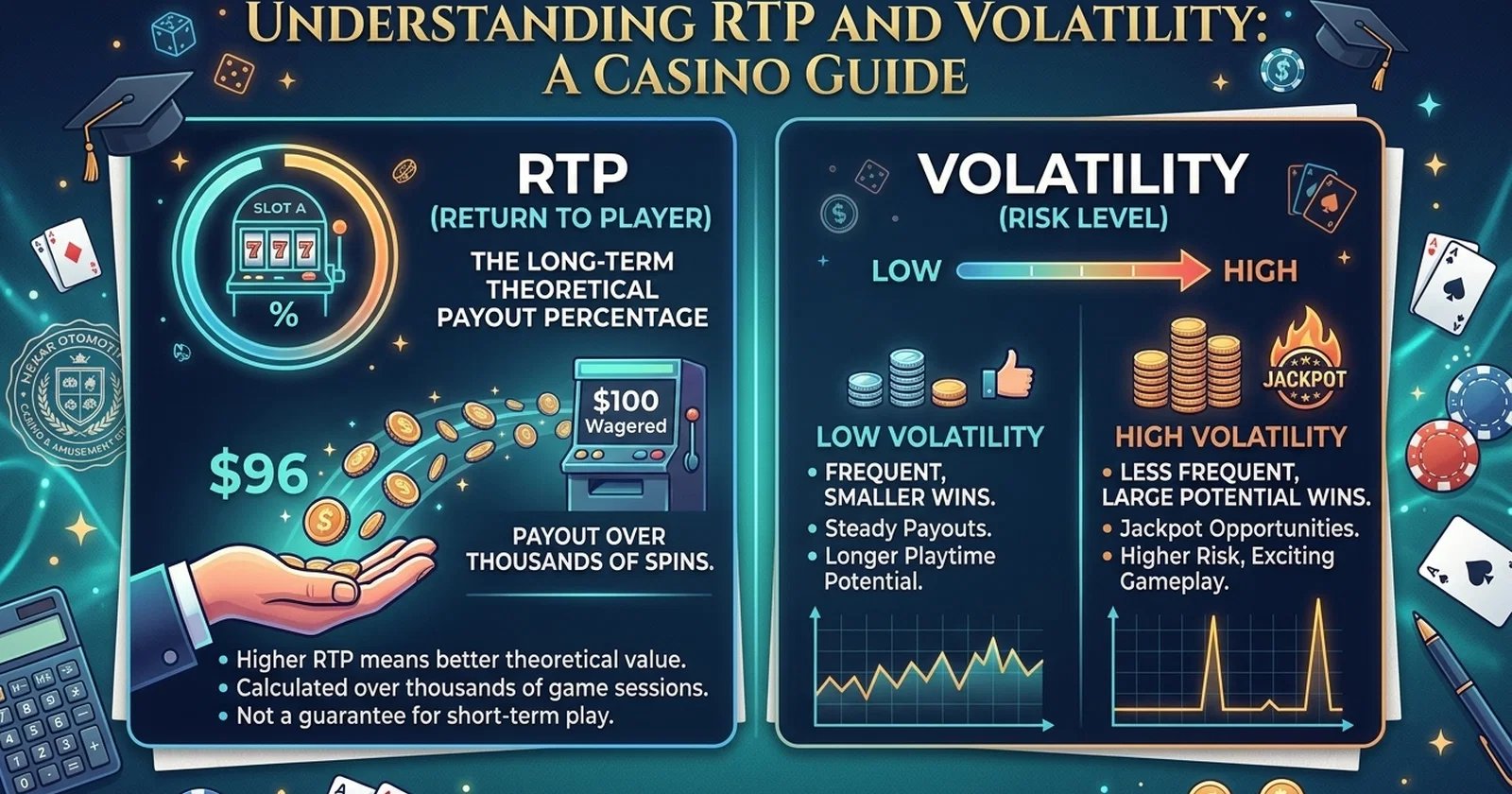
Two slot games can look identical and behave completely differently. One pays small amounts every few spins. The other stays quiet for twenty minutes and then drops a win that covers your entire session. The difference is not luck. It is RTP and volatility, and understanding both changes the way you choose games.
Most players know the terms. Far fewer know how to use them. This guide explains what each number means, how they interact, and how to match a game to your budget instead of your hope.
Understanding RTP and Volatility in Slot Games
RTP, or Return to Player, is the percentage of all money wagered on a slot that the game is designed to pay back over time. A 96 percent RTP means the game returns 96 units for every 100 wagered, on average, across millions of spins.
Volatility, sometimes called variance, describes how those returns are distributed. High volatility means rare but large wins. Low volatility means frequent but small wins. Both games can have the same RTP and still feel completely different to play.
What RTP Actually Tells You
RTP is a long-term average. It is not a promise for your session, your week, or your month. A slot with 96 percent RTP can still drain a 100 unit balance in twenty minutes. That is not the game malfunctioning. That is variance doing what variance does.
Where RTP becomes useful is comparison. If two slots have similar volatility, the one with higher RTP gives you slightly better long-term value. Over hundreds of sessions, that difference adds up. Over one session, it is almost invisible.
RTP also varies by game type. Many online slots sit between 95 and 97 percent. Live dealer games often sit lower, sometimes 97 percent on some bets and much lower on others. Table games like blackjack can exceed 99 percent with correct strategy, which is why serious players often prefer them.
How Volatility Changes the Experience
Volatility is the more practical number for session planning. It tells you what to expect from your bankroll.
| Volatility Level | Typical Hit Frequency | Win Character | Session Feel |
|---|---|---|---|
| Low | 1 in 3 to 1 in 5 spins | Small, steady | Balance drifts slowly |
| Medium | 1 in 5 to 1 in 10 spins | Mixed | Ups and downs, moderate swings |
| High | 1 in 10 to 1 in 50 spins or rarer | Rare, large | Long dry spells, sudden spikes |
A player with 30 units who wants an hour of play should avoid high volatility. A player with 200 units who wants a shot at a large payout can accept the dry spells that come with it. The same game suits one and frustrates the other.
Why RTP and Volatility Are Not the Same
This is where many players get confused. A high volatility slot and a low volatility slot can both have 96 percent RTP. The difference is not how much the game pays back. It is when and how.
Think of it this way. Two games both return 96 units per 100 wagered. Game A returns those 96 units in small pieces across many spins. Game B returns them in a few large pieces across thousands of spins. Same total, different rhythm.
If you judge a game only by RTP, you miss the rhythm. If you judge only by volatility, you miss the long-term value. You need both to make a good choice.
Reading the Numbers Before You Play
Most licensed casinos publish RTP in the game information screen. Some list it in the game lobby. If you cannot find it, that is a signal. Reputable operators make this information easy to access.
Volatility is less standardized. Some providers label it directly as low, medium, or high. Others describe it in the game notes. If neither is available, you can estimate by watching the paytable. Games with huge maximum wins relative to stake tend to be high volatility. Games with modest maximum wins tend to be lower.
If you are trying a new game, run it in demo mode for a few hundred spins. That will not tell you the RTP, but it will show you the rhythm. You will quickly feel whether wins come often or rarely.
Matching the Game to Your Plan
Start with two decisions. How much are you willing to lose, and how long do you want the session to last?
If the answer is a small budget and a long session, low volatility is the fit. Your balance will drift downward slowly, and you will get more spins for your money.
If the answer is a larger budget and a willingness to risk it for a big hit, high volatility can work. Just go in knowing that most sessions will end without a large win. That is the nature of the format.
If you are unsure, medium volatility is a reasonable middle ground. It gives you a mix of small wins and occasional larger ones without the extreme dry spells of high volatility games.
Finding Games and Platforms
If you want to compare slots by RTP and volatility, ankertoto is one place to start. Look for a platform that lists RTP clearly on each game page and separates slots by volatility, so you can filter without guessing.
Good platforms also offer demo play. Use it. Running a game in demo for 200 spins costs nothing and tells you more than any review.
Final Thoughts
RTP and volatility are the two numbers that matter most when choosing a slot. RTP tells you the long-term cost of playing. Volatility tells you what the ride will feel like.
Neither number lets you beat the house. That is not the point. The point is to pick a game whose rhythm matches your budget and your patience, so the session stays entertaining instead of frustrating. Do that, and you will get far more out of your playtime than players who choose by theme alone.
Frequently Asked Questions
Does higher RTP mean I will win more?
Not in a single session. Higher RTP means the game is designed to keep less over the long run. Over one session, variance dominates. Over thousands of spins, RTP becomes visible.
Which is better, high or low volatility?
Neither. Low volatility suits small budgets and long sessions. High volatility suits players who accept long dry spells for a chance at a large win. The right choice depends on your budget and patience.
Can I find RTP for every slot?
Licensed operators usually publish it in the game information screen. If a site hides RTP or does not provide it, that is a warning sign. Reputable platforms make this information easy to find.
Is volatility the same as variance?
In slot terminology, yes. Both describe how widely results swing around the average. Higher volatility means larger swings in both directions.
Should I avoid low RTP slots entirely?
Not necessarily. A game with slightly lower RTP but a theme and feature set you enjoy can still be a reasonable choice for casual play. RTP is one factor, not the only one.
More in Online Games
 Online Games
Find Online Game Communities That Share a Rider Mindset
Finding people who think the way you do is harder than it sounds, whether the context is a riding group or an online game...
 Online Games
Discover How Online Game Worlds Mirror Motorcycle Racing
Riding a real motorcycle and racing one inside an online game draw on surprisingly similar instincts, even though only one of...
 Online Games
Tips for Managing Your Bankroll in Online Games
Bankroll management, deciding how much you are willing to spend and sticking to it, is one of the most important habits in...