
Choosing Artificial Plants for Room With No Natural Light
Rooms without natural light are the hardest place to put a real plant and the easiest place to put a fake one. That sounds like a simple win.
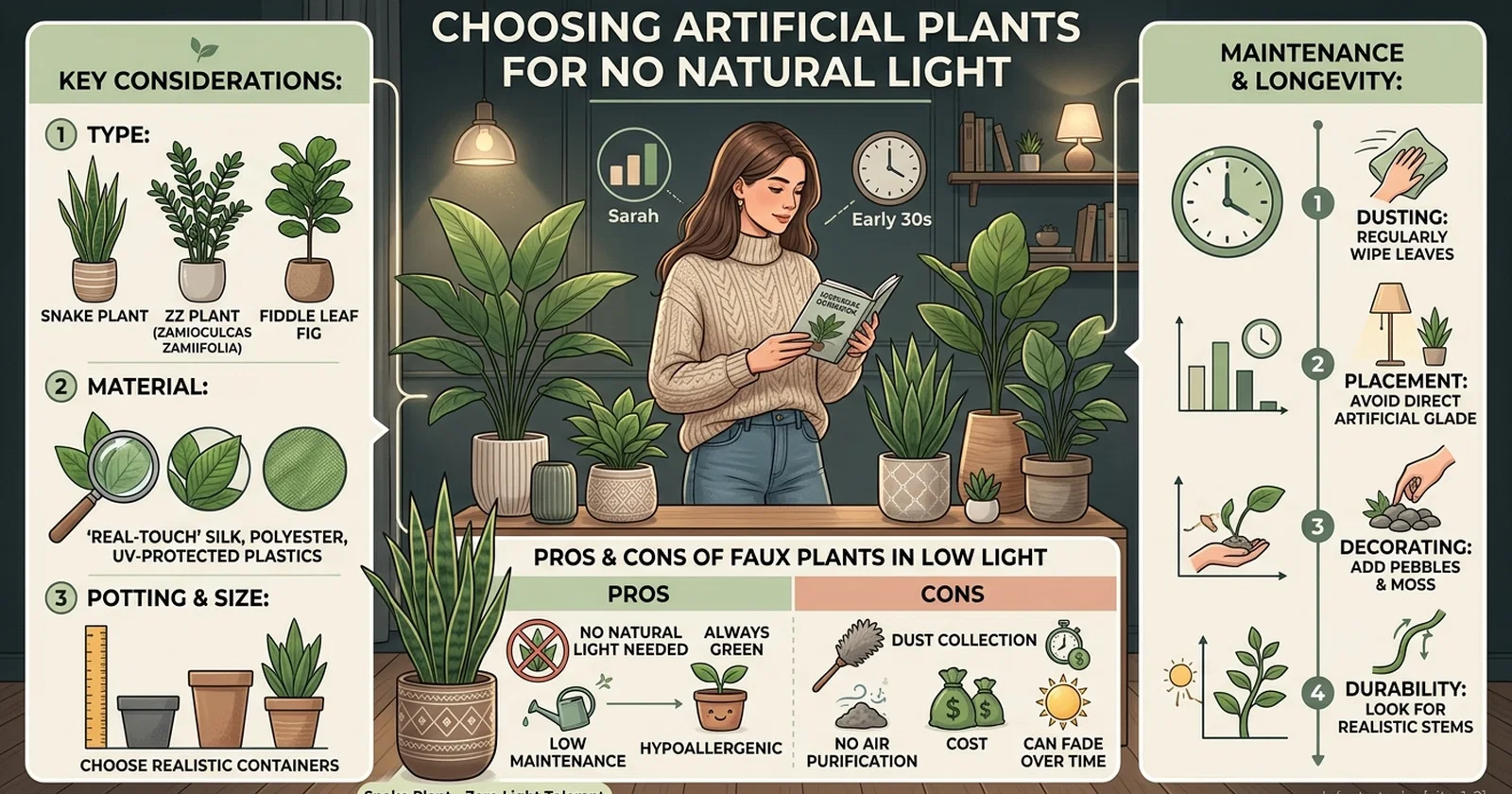
Rooms without natural light are the hardest place to put a real plant and the easiest place to put a fake one. That sounds like a simple win. It is not, because the same absence of light that kills real plants also changes how an artificial plant reads to the eye, and most people get this wrong the first time.
A dark room is not simply a room with less light. It has different color temperature, different shadows, and different expectations from anyone standing in it. A plant chosen for a bright living room often looks wrong in a basement, and the reason is never the plant itself.
Choosing Artificial Plants for Rooms With No Natural Light
The short answer: in a room with no natural light, you need a plant with lighter foliage, a softer silhouette, and a matte finish. Glossy dark green leaves that look rich in daylight look like plastic in a dim room. Lighter, matte leaves read as real because they match what the eye expects from artificial light.
The rest of this article explains why, and how to apply it when you are standing in a shop or scrolling a product page.
Why Dark Rooms Change How a Plant Reads
Color is not a property of an object. It is a product of light hitting the object and your eye interpreting the result. Change the light, and the color changes with it.
Daylight is broad-spectrum and relatively cool. It brings out the depth in dark green leaves and makes glossy surfaces sparkle in a way the eye reads as healthy. Artificial light, especially warm indoor lighting, is narrower. It flattens dark greens into a single dull tone and turns gloss into a flat sheen.
This is why a plant that looks great in a garden centre looks cheap in a basement den. The plant did not change. The light did.
The Three Features That Matter in Low Light
When you cannot rely on light to flatter a plant, you have to rely on the plant's own features. Three matter more than the rest.
| Feature | What to Look For | Why It Matters in Low Light |
|---|---|---|
| Leaf color | Medium to light green, variegated, or olive | Dark greens flatten into one tone under warm light |
| Surface finish | Matte or satin, not high gloss | Gloss reflects the light source and reads as plastic |
| Silhouette | Open, airy, visible gaps between leaves | Dense foliage becomes a solid mass in shadow |
If you remember nothing else, remember this: light leaves, matte finish, open shape. That combination works in almost any low-light room.
Matching the Plant to the Room
Not every dark room is the same, and the right plant depends on which kind of dark room you have.
A basement den is usually the darkest and has the lowest ceiling. Here, a tall plant will dominate the space and cast shadows that make the room feel smaller. Choose something waist-high or below, with a wide rather than tall shape, so it fills a corner without competing with the ceiling.
A home bar corner is darker still, but often has focused lighting above the counter. In that setting, a plant placed just outside the pool of light reads better than one in the light itself. The contrast gives it depth.
A windowless bathroom is a special case. Humidity is high, and cheap artificial plants can develop a musty smell if they are fabric. Choose plastic or coated fabric for bathrooms, and keep them away from direct contact with water.
A hallway with no windows but overhead light is the easiest of the four. The light is even, if flat. Any medium green plant with a matte finish will work, provided it is sized to the hallway and not blocking movement.
What to Avoid
Avoid anything described as "real touch" or "silk" for a dark room. These finishes are designed to look convincing in daylight, where the texture can be seen. In low light, the texture disappears and you are left with the color and shape alone. If those two are wrong, the finish does not save it.
Avoid very dark green leaves. They are the single most common mistake. A deep forest green that looks elegant in a bright room turns almost black in a dim one, and reads as a shadow rather than a plant.
Avoid dense, bushy shapes. A plant that looks full and healthy in daylight becomes a shapeless mass in a dark corner. Open shapes with visible stems and gaps read better because the eye can distinguish individual leaves.
Placement and Light Sources
Where you put the plant in a dark room matters as much as what you buy. Two rules help.
First, place the plant so that some light source, any light source, falls on it from the front or side. A plant in a corner with the light behind it is a silhouette. A plant with light on its face shows its color.
Second, avoid placing it directly under a downlight. The light will pool on the top leaves and leave the rest in shadow, which flattens the shape. Offset placement gives more even coverage.
If the room has no light source at all, which is rare, the plant is decoration for a room nobody sits in. In that case, buy for shape, not color. Nobody will see the color.
Final Thoughts
A room with no natural light is not a problem for artificial plants. It is a different design brief. The rules that work in a bright room do not apply, and applying them anyway is why so many fake plants in dark rooms look fake.
Choose light or variegated leaves over dark green. Choose matte over gloss. Choose open shapes over dense ones. Place the plant where some light falls on its face. Do those four things and even a basement corner can hold a plant that reads as real.
Frequently Asked Questions
Can artificial plants look real in a dark room?
Yes, if you choose for low light. Lighter leaves, matte finishes, and open shapes read better in dim conditions than dark, glossy, dense plants.
What color artificial plant is best for a windowless room?
Medium green, olive, or variegated leaves work best. Avoid deep forest green, which turns almost black under warm indoor lighting.
Should I use fabric or plastic plants in a basement?
Plastic or coated fabric is better for basements because humidity can affect untreated fabric. If the basement is dry, either works, but check the finish before buying.
How big should an artificial plant be in a low-ceiling room?
Waist-high or below, with a wide rather than tall shape. A tall plant in a low-ceiling room dominates the space and casts shadows that make the room feel smaller.
Does placement matter in a dark room?
Yes. Place the plant so light falls on its front or side. A uneplanteartificielle
lit from behind becomes a silhouette, and its color disappears.
More in Perawatan Motor
 Perawatan Motor
Cara Merawat Shockbreaker Motor agar Tidak Cepat Bocor
Merawat shockbreaker motor sebenarnya tidak butuh alat mahal atau keahlian khusus, tapi justru bagian ini paling sering...
 Perawatan Motor
Shockbreaker Motor untuk Apa? Fungsinya bagi Kenyamanan
Pertanyaan shockbreaker motor untuk apa mungkin terdengar dasar, tapi banyak pemilik motor yang sebenarnya belum paham betul...
 Perawatan Motor
Umur Kampas Rem Motor dan Faktor yang Memengaruhinya
Umur kampas rem motor sebenarnya bukan angka tetap yang berlaku sama untuk semua motor.